
Poolside AI
Paid ✓ VerifiedPoolside AI builds large language models trained specifically on code, targeting enterprise software engineering workflows and developer tooling.
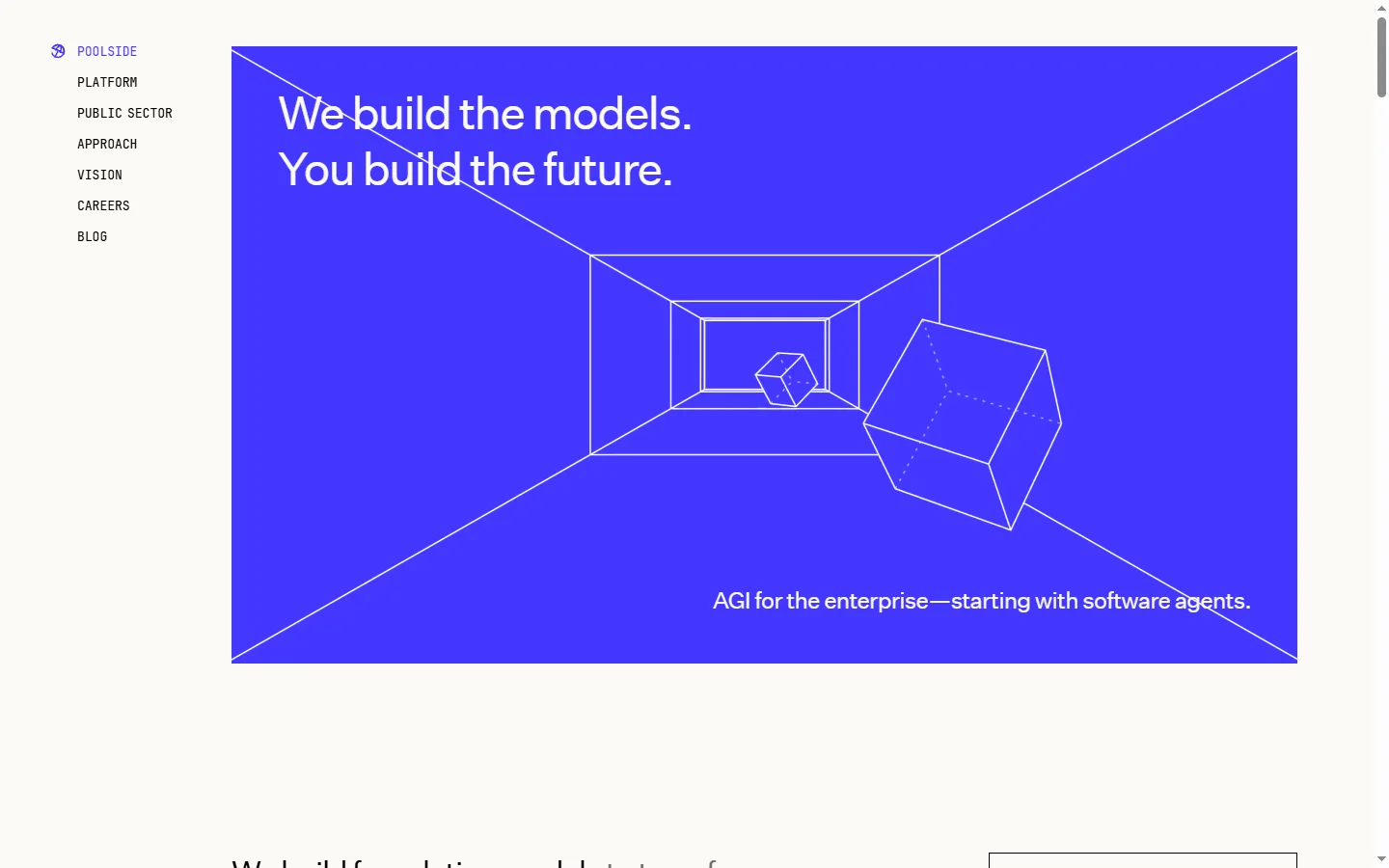
📋 About Poolside AI
Poolside AI is an enterprise AI company developing large language models trained primarily on code with the explicit goal of building AI systems that can reason about and produce software at the level needed for real engineering work. The company's research approach focuses on reinforcement learning from code execution — training models through millions of coding tasks where the output is tested against real execution results, rather than relying solely on human preference feedback. This execution-based training signal is intended to produce models with more reliable reasoning about code correctness than models trained on human rating alone.
Poolside positions its models as the foundation for enterprise developer tools — AI code generators, autonomous coding agents, and software engineering workflows that need to be reliable enough for production codebases at large organizations. The company targets enterprises with significant software engineering operations that require code-capable AI that can be deployed securely within controlled infrastructure rather than through consumer-facing cloud services.
As of early 2026, Poolside AI is in the process of making its models available to enterprise partners through its platform and API, having raised substantial funding to build out both the model development and deployment infrastructure. The focus is on the frontier of code-capable AI rather than general-purpose conversational AI, competing in the emerging category of specialized coding foundation models alongside other code-focused AI labs.
⚡ Key Features of Poolside AI
Execution-Based Model Training
Poolside ai trains its models using reinforcement learning signals derived from actual code execution results rather than relying solely on human preference annotations. When a generated code solution is tested and fails, that failure signal flows back into the training process — the same way a developer learns from running code that breaks. This approach is designed to produce models that reason about code correctness more reliably than those trained exclusively on human evaluations of code quality.
Code Generation and Completion
The poolside ai models generate, complete, and refactor code across major programming languages with a focus on the accuracy and reliability required for production engineering contexts. The models are designed to handle complex multi-file and multi-function generation tasks, not just autocomplete of simple snippets. Outputs include documentation, test generation, and code explanation alongside the implementation code.
Enterprise Security and Deployment
Poolside ai is designed from the outset for enterprise security requirements — supporting private deployment options that keep code and query data within the enterprise's controlled infrastructure rather than routing through external consumer cloud services. This addresses the core concern that prevents many large organizations from using consumer-grade AI coding tools on their proprietary codebases and internal systems.
Long-Context Codebase Reasoning
Poolside ai models support long context windows designed to hold large portions of a codebase in context simultaneously, enabling reasoning about code dependencies, architecture patterns, and cross-file relationships that short-context models cannot maintain. This is essential for AI-assisted engineering work on real enterprise codebases, which cannot be reduced to isolated function-level tasks.
API Access for Developer Tool Integration
Poolside ai exposes its models through an API that enterprise software teams and tooling vendors can use to build coding assistants, automated testing pipelines, and development workflow tools on top of the poolside models. This allows organizations to incorporate poolside's code capabilities into their existing development toolchain rather than adopting a standalone interface.
Autonomous Coding Agent Capabilities
Beyond single-step code generation, poolside ai is developing agent-mode capabilities in which the model can plan, implement, test, and iterate on multi-step coding tasks with minimal human intervention between steps. This positions the platform for the emerging use case of AI-driven software engineering tasks that span planning and execution, not just code suggestion.
🎯 Use Cases for Poolside AI
⚖️ Poolside AI Pros & Cons
Advantages
- ✓Execution-based training signal targets a genuine gap in how code-capable models are developed
- ✓Enterprise-first security and deployment model addresses the primary adoption barrier in large organizations
- ✓Code-specialized training rather than general-purpose models repurposed for coding
- ✓Long context support enables reasoning about real codebases beyond isolated snippets
Drawbacks
- ✗Enterprise-only pricing and positioning makes it inaccessible for individual developers and small teams
- ✗Still in early deployment phase as of 2026 — broad enterprise availability is not yet fully established
- ✗Competing against well-resourced incumbents including OpenAI Codex, GitHub Copilot, and Cursor
- ✗API-only access means no out-of-the-box end-user interface without additional tooling investment
📖 How to Use Poolside AI
Contact Poolside through poolside.ai to initiate an enterprise partnership or API access discussion.
Work with the Poolside team to assess deployment options — shared API or private deployment within your infrastructure.
Integrate the Poolside API into your existing development toolchain, IDE plugin, or internal coding assistant.
Configure the context window and retrieval approach for your codebase size and architecture.
Run a pilot on a defined set of engineering tasks to benchmark accuracy and productivity impact against your baseline.
Expand deployment based on pilot results and refine the integration for your specific engineering workflows.
❓ Poolside AI FAQ
Poolside ai's core differentiation is training models using execution-based reinforcement learning rather than human preference data alone. This trains the model to reason about whether code actually works, not just whether it looks correct to a human reviewer. The enterprise deployment focus and long-context architecture are additional differentiators.
Poolside ai is currently positioned for enterprise and developer tool company partnerships rather than individual developer access. Individual developers should check poolside.ai for any current direct access programs or public beta availability.
Poolside ai supports major programming languages as part of its code-specialized training. Specific language coverage and performance benchmarks are available through the enterprise engagement process and on the poolside.ai site.
Poolside ai offers private deployment options for enterprise clients — check poolside.ai and engage with the team for specific deployment architecture options including on-premises or private cloud configurations.
Related to Poolside AI


Featured on WhatIf.ai
Add this badge to your website to show you're listed on WhatIf AI
Alternatives to Poolside AI


Base44 AI
Base44 AI is an AI app builder and website builder that generates full-stack web applications from natural language descriptions with backend, database, and UI included.

Browse AI
Browse AI is a no-code web scraping and monitoring tool that extracts structured data from any website and tracks changes over time without writing code.

Cantina AI
Cantina AI is a freemium platform for building and deploying full-stack web applications using AI-assisted development with live preview and one-click deployment.

ChatGPT
ChatGPT AI assistant by OpenAI for writing, coding, research, image analysis, and everyday problem-solving.