
Crusoe AI
Paid ✓ VerifiedCrusoe AI provides GPU cloud computing infrastructure for AI training and inference workloads, powered by stranded and flared energy sources.
📋 About Crusoe AI
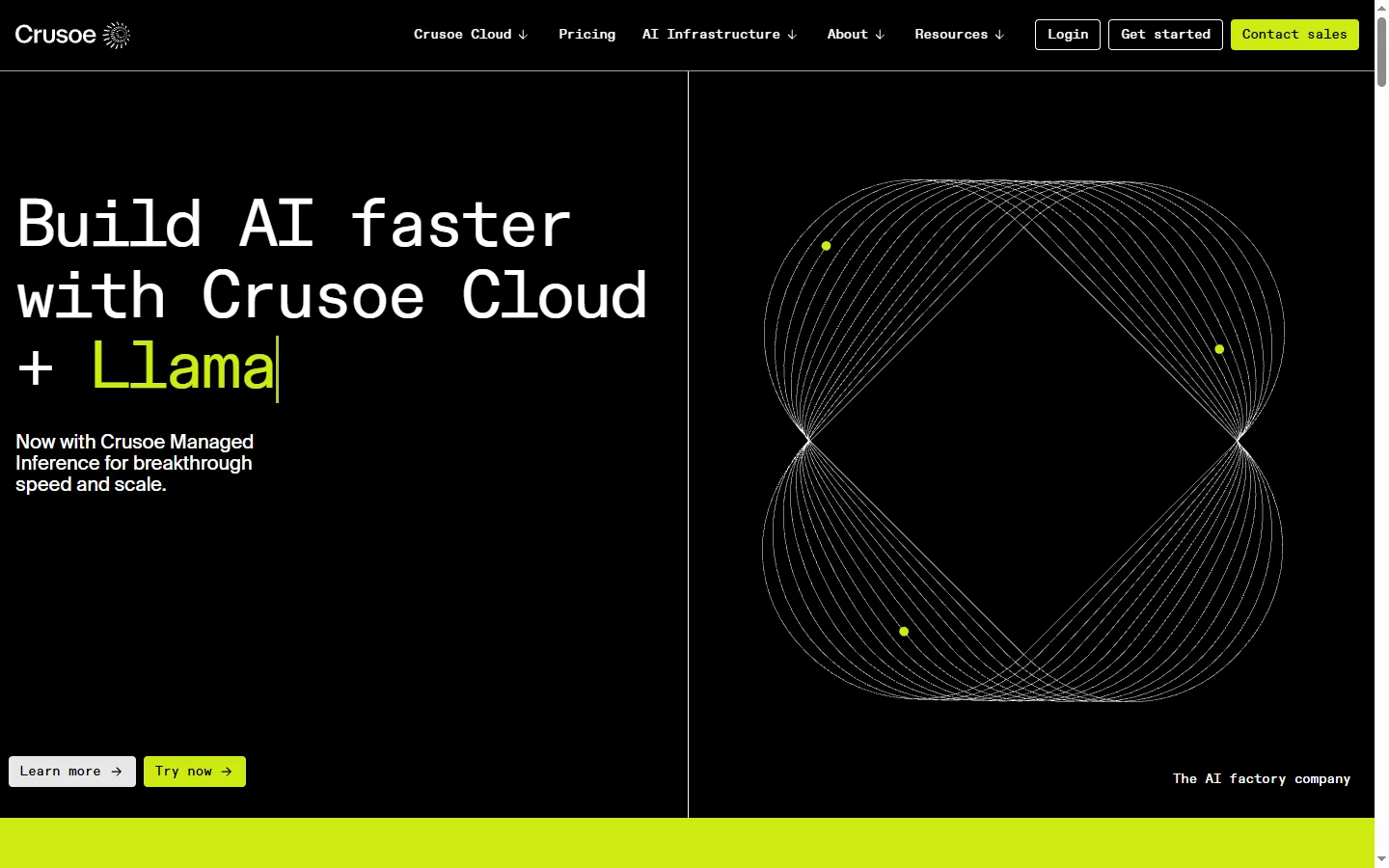
Crusoe AI is a cloud computing company that provides GPU infrastructure for AI training and inference workloads, built on a differentiated energy sourcing model. The company's data centers are co-located with stranded and flared natural gas operations — primarily in oil and gas fields — where it captures energy that would otherwise be burned off or wasted and converts it to electricity to power computing. This energy model gives Crusoe a cost and sustainability position that differentiates it from standard GPU cloud providers competing purely on hardware allocation.
For AI teams, Crusoe offers the same categories of cloud GPU access — on-demand and reserved instances running NVIDIA H100 and A100 GPUs, Kubernetes-based cluster orchestration, and storage integrated with compute — that hyperscale cloud providers offer, but at pricing that reflects their lower energy cost basis. The platform supports the full range of AI infrastructure use cases: large model training runs, fine-tuning, batch inference pipelines, and interactive inference serving.
Crusoe targets AI research labs, enterprise AI teams, and cloud-native companies running significant GPU workloads who are looking for an alternative to the major hyperscalers on either cost or sustainability grounds. The company has grown its GPU fleet significantly since 2023 and is building toward large-scale cluster capacity aimed at the frontier model training market alongside its inference and general compute offerings.
⚡ Key Features of Crusoe AI
GPU Instance Access
Crusoe ai provides on-demand and reserved GPU instance access running NVIDIA H100 and A100 GPUs, covering the hardware tiers needed for both large-scale training runs and production inference serving. Instance configurations range from single-GPU development environments to multi-node clusters for distributed training. On-demand access supports variable workloads while reserved instances reduce per-hour costs for teams with predictable long-running compute requirements.
Large-Scale Training Cluster
Crusoe ai is building and operating large GPU clusters designed for frontier-scale model training, targeting AI labs and enterprises that need to run multi-thousand GPU training jobs without the queue times and allocation constraints common with hyperscale cloud GPU capacity. The cluster interconnect architecture uses high-bandwidth networking appropriate for distributed training workloads where inter-GPU communication is a bottleneck. Crusoe's energy sourcing model positions it as a cost-competitive option for the most compute-intensive training jobs.
Energy-Differentiated Pricing
Crusoe ai's compute pricing reflects its lower energy cost basis from stranded and flared gas utilization, offering GPU instance pricing that competes with and in many cases undercuts hyperscale cloud GPU on-demand rates. For teams running sustained GPU workloads, energy cost is a significant component of total infrastructure cost, making Crusoe's pricing model directly relevant to budget planning. Reserved instance pricing amplifies the per-hour cost advantage for predictable long-running workloads.
Kubernetes and Orchestration
Crusoe ai supports Kubernetes-based cluster orchestration for teams that want to manage containerized AI workloads using familiar cloud-native tools. This allows teams already using Kubernetes for container orchestration to run workloads on Crusoe infrastructure without adapting to a proprietary scheduling system. Standard Kubernetes tooling for job scheduling, autoscaling, and resource management applies to Crusoe compute.
Integrated Storage
High-throughput storage integrated with compute is available to avoid the I/O bottlenecks that occur when training data and model checkpoints must transfer over external network connections. Storage is designed to meet the I/O demands of large training runs where dataset streaming and checkpoint write performance are critical to training efficiency. Storage and compute billing are managed through the same account.
Inference Serving Infrastructure
Beyond training, crusoe ai provides GPU infrastructure for production inference serving — deploying trained models to serve API requests at the throughput and latency levels required for production applications. Inference deployment supports standard serving frameworks including vLLM and Triton, allowing teams to bring their trained models to production without migrating to a different cloud environment than the one used for training.
🎯 Use Cases for Crusoe AI
⚖️ Crusoe AI Pros & Cons
Advantages
- ✓Energy-differentiated cost model produces genuine pricing competitiveness on GPU compute
- ✓NVIDIA H100 and A100 availability covers the current hardware requirements for most training and inference workloads
- ✓Kubernetes compatibility reduces operational friction for teams with existing cloud-native tooling
- ✓Sustainability angle resonates with organizations that have carbon reduction commitments
Drawbacks
- ✗Smaller ecosystem of services and regions compared to hyperscale cloud providers
- ✗Geographic availability is limited by where stranded energy sources are co-located
- ✗Enterprise procurement and support processes are less mature than AWS, GCP, or Azure for large-scale deployments
- ✗Data residency and compliance tooling may be less comprehensive than hyperscale alternatives
📖 How to Use Crusoe AI
Go to crusoe.ai and create an account to access the cloud console.
Review available GPU instance types and pricing — select the hardware tier appropriate for your workload.
Configure a GPU instance or cluster with the compute, memory, and storage specifications your training or inference workload requires.
Deploy your training job or inference server using standard tools — Docker containers, Kubernetes manifests, or framework-specific launchers.
Monitor resource utilization and job progress through the Crusoe console or standard Kubernetes monitoring tooling.
Retrieve outputs — trained model checkpoints, inference logs, or exported artifacts — from integrated storage at job completion.
❓ Crusoe AI FAQ
Crusoe ai offers NVIDIA H100 and A100 GPU instances, covering the hardware most commonly used for large model training and production inference. Specific instance types, configurations, and availability are listed on crusoe.ai.
Crusoe ai co-locates data centers with stranded and flared gas operations, capturing energy that would otherwise be wasted or directly emitted as CO2 via flaring. This energy is converted to electricity to power the GPU infrastructure. The resulting lower energy cost is reflected in compute pricing.
Yes, crusoe ai supports production inference workloads using standard serving frameworks including vLLM and Triton. The infrastructure is appropriate for sustained high-throughput inference serving, not just training runs.
Crusoe ai focuses specifically on GPU compute with a cost and sustainability differentiation, while hyperscale providers offer broader service ecosystems. Crusoe is best evaluated as a focused alternative for GPU-intensive AI workloads where compute cost is a primary concern, not as a full cloud platform replacement.
Related to Crusoe AI

Fireworks AI
Fireworks AI provides fast, cost-efficient API inference for open-source LLMs and image models with fine-tuning and private deployment support.

Poolside AI
Poolside AI builds large language models trained specifically on code, targeting enterprise software engineering workflows and developer tooling.
Featured on WhatIf.ai
Add this badge to your website to show you're listed on WhatIf AI
Alternatives to Crusoe AI


Base44 AI
Base44 AI is an AI app builder and website builder that generates full-stack web applications from natural language descriptions with backend, database, and UI included.

Browse AI
Browse AI is a no-code web scraping and monitoring tool that extracts structured data from any website and tracks changes over time without writing code.

Cantina AI
Cantina AI is a freemium platform for building and deploying full-stack web applications using AI-assisted development with live preview and one-click deployment.

ChatGPT
ChatGPT AI assistant by OpenAI for writing, coding, research, image analysis, and everyday problem-solving.