
Etched AI
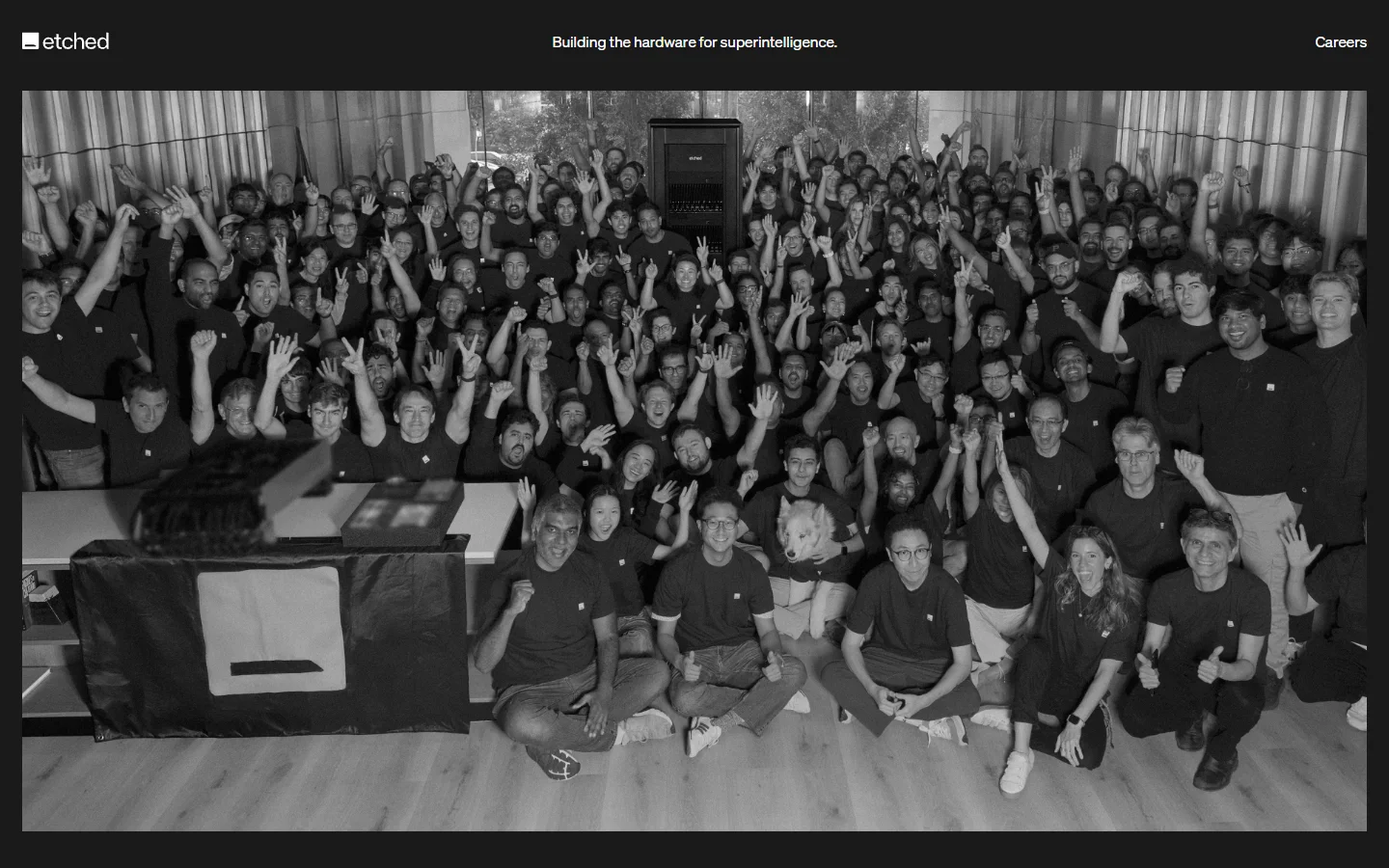
Paid ✓ VerifiedEtched AI custom silicon company building transformer-optimized ASICs for high-throughput AI inference at lower cost than GPU infrastructure.
📋 About Etched AI
Etched AI is an etched ai AI inference hardware company building custom silicon specifically designed to run transformer-based AI models more efficiently than general-purpose GPU infrastructure. The company's approach is to design an application-specific integrated circuit, or ASIC, optimized for the mathematical operations that transformers require, rather than running AI workloads on GPUs designed for broader computational tasks. The premise is that transformer workloads are sufficiently dominant and distinct that purpose-built hardware can deliver significantly better performance per watt and per dollar than GPU clusters running the same models.
The Etched chip is designed to run large language models and other transformer-architecture models at very high throughput and lower cost than equivalent GPU deployments. For organizations running AI inference at scale, where the cost of serving model responses at volume is a significant operational expense, hardware efficiency translates directly to economics. Etched targets this infrastructure cost problem rather than the model development layer, positioning its chips as the substrate on which deployed AI runs.
Etched AI operates as a hardware and infrastructure company with paid access to its compute offerings. It is a verified platform in the AI developer tools and infrastructure space. The company competes with GPU providers and other AI chip companies including Groq and Cerebras in the custom AI silicon market, and its technology is relevant to AI developers, cloud infrastructure teams, and enterprises running high-throughput inference workloads at scale.
⚡ Key Features of Etched AI
Transformer-Optimized ASIC Architecture
Designs custom silicon at the chip level specifically for the matrix multiplication and attention mechanism operations that dominate transformer model inference, unlike GPUs designed for general parallel computation. Transformer-specific optimization allows the hardware to eliminate the overhead that GPUs incur when adapted for workloads they were not designed for, improving effective throughput per chip. The fixed-function design trades flexibility for efficiency, meaning the chip is maximally optimized for transformer inference specifically. This represents a deliberate bet that transformers will remain the dominant AI architecture for the foreseeable future.
High-Throughput Inference Performance
Delivers high token generation throughput for large language model inference, targeting the performance requirements of production deployments that serve many simultaneous users. Throughput performance is the primary metric that matters for inference economics since it determines how many requests can be served per unit of hardware cost. Benchmark comparisons against GPU infrastructure are a core part of Etched's technical positioning. Organizations with high query volumes benefit most from throughput improvements since hardware costs scale directly with request volume.
Inference Cost Efficiency
Reduces the cost per inference token compared to equivalent GPU-based infrastructure by delivering more throughput per dollar of hardware capital and per watt of power consumption. For organizations running large-scale AI inference, the economics of serving model responses at high volume make hardware efficiency a significant cost driver. Etched's positioning is that transformer-specific silicon can deliver substantially better cost-per-token economics than general-purpose GPU clusters at equivalent model quality. Cost efficiency claims are model-dependent and should be evaluated against specific deployment configurations.
Large Language Model Support
Supports running major transformer-based large language models including open-weight models in the LLaMA family and other widely deployed transformer architectures used in production inference. Model compatibility is a practical requirement since organizations deploying at scale are running specific model families and need infrastructure that supports their chosen models. Support coverage should be confirmed with Etched for specific models relevant to a given deployment context. Model support may expand as the platform develops.
Developer and Deployment Interface
Provides APIs and developer tooling that allow AI engineering teams to deploy models on Etched infrastructure using familiar interfaces rather than requiring hardware-specific programming expertise. Abstraction layers mean that developers do not need to program the chip directly to run inference workloads on it. Integration with existing model serving frameworks reduces the migration effort required to move from GPU infrastructure. Developer documentation and integration support are available for qualified customers during early access.
Power and Thermal Efficiency
Achieves better performance per watt than GPU-based inference infrastructure, reducing both the direct power costs and the cooling infrastructure requirements associated with large-scale AI serving. Power efficiency matters increasingly as AI inference scales, with data center power consumption becoming a meaningful cost and sustainability consideration for large deployments. Thermal efficiency reduces the hardware density and cooling requirements needed to achieve a given inference throughput. Power figures should be evaluated against specific deployment configurations and compared against current GPU alternatives.
🎯 Use Cases for Etched AI
⚖️ Etched AI Pros & Cons
Advantages
- ✓Transformer-specific ASIC design delivers better inference efficiency than general-purpose GPUs for the dominant AI model architecture
- ✓Targets the inference cost problem directly, which is a growing expense for organizations running AI at production scale
- ✓Power and thermal efficiency improvements reduce data center operational costs alongside capital costs
- ✓Verified platform status reflects established credibility in the AI infrastructure space
- ✓Developer-friendly APIs reduce migration effort from existing GPU-based inference workflows
Drawbacks
- ✗Fixed-function transformer optimization means the hardware has no value for non-transformer AI workloads or general compute tasks
- ✗As a newer hardware company, production availability, supply chain reliability, and long-term support commitments carry more uncertainty than established GPU providers
- ✗Cost and performance claims should be independently validated against specific deployment configurations rather than accepted from vendor benchmarks alone
📖 How to Use Etched AI
Contact Etched AI through etched.ai to discuss access options, availability, and deployment requirements for your inference workload.
Provide details about your current model deployment including model family, request volume, and current infrastructure costs to allow a meaningful comparison.
Work with the Etched team to evaluate compatibility between your target models and the current chip's supported architecture and model formats.
Access developer documentation and APIs to understand how to configure model deployment on Etched infrastructure using existing serving frameworks.
Run benchmark evaluations comparing Etched inference performance and cost against your current GPU infrastructure on representative workloads.
Plan a migration or pilot deployment with support from the Etched team to validate real-world performance before full production transition.
❓ Etched AI FAQ
Etched AI builds ASICs designed specifically for transformer model operations rather than running AI on general-purpose GPUs. Transformer-specific hardware eliminates overhead from GPU generality, delivering better throughput and efficiency for the specific mathematical operations that transformers require at the cost of flexibility for other workload types.
Etched AI targets transformer-based large language models including major open-weight model families used in production inference. Specific model compatibility details should be confirmed directly with Etched for the models relevant to your deployment.
Etched AI is available through direct engagement rather than broad self-serve purchase. Organizations interested in deploying on Etched infrastructure should contact the company through etched.ai to discuss availability, pricing, and deployment options.
Etched AI and Groq both build custom silicon for AI inference to improve on GPU performance and economics. The technical approaches and specific performance characteristics differ between the two. Organizations evaluating custom AI silicon should benchmark both against their specific model and workload requirements rather than relying on general comparisons.
Etched AI provides developer APIs and tooling designed to integrate with existing model serving workflows, reducing the engineering effort required to migrate from GPU infrastructure. Specific framework compatibility should be confirmed with Etched for the serving stack relevant to your deployment.
Related to Etched AI

Crusoe AI
Crusoe AI provides GPU cloud computing infrastructure for AI training and inference workloads, powered by stranded and flared energy sources.

Fireworks AI
Fireworks AI provides fast, cost-efficient API inference for open-source LLMs and image models with fine-tuning and private deployment support.
Featured on WhatIf.ai
Add this badge to your website to show you're listed on WhatIf AI
Alternatives to Etched AI


Base44 AI
Base44 AI is an AI app builder and website builder that generates full-stack web applications from natural language descriptions with backend, database, and UI included.

Browse AI
Browse AI is a no-code web scraping and monitoring tool that extracts structured data from any website and tracks changes over time without writing code.

Cantina AI
Cantina AI is a freemium platform for building and deploying full-stack web applications using AI-assisted development with live preview and one-click deployment.

ChatGPT
ChatGPT AI assistant by OpenAI for writing, coding, research, image analysis, and everyday problem-solving.