
Tripo AI
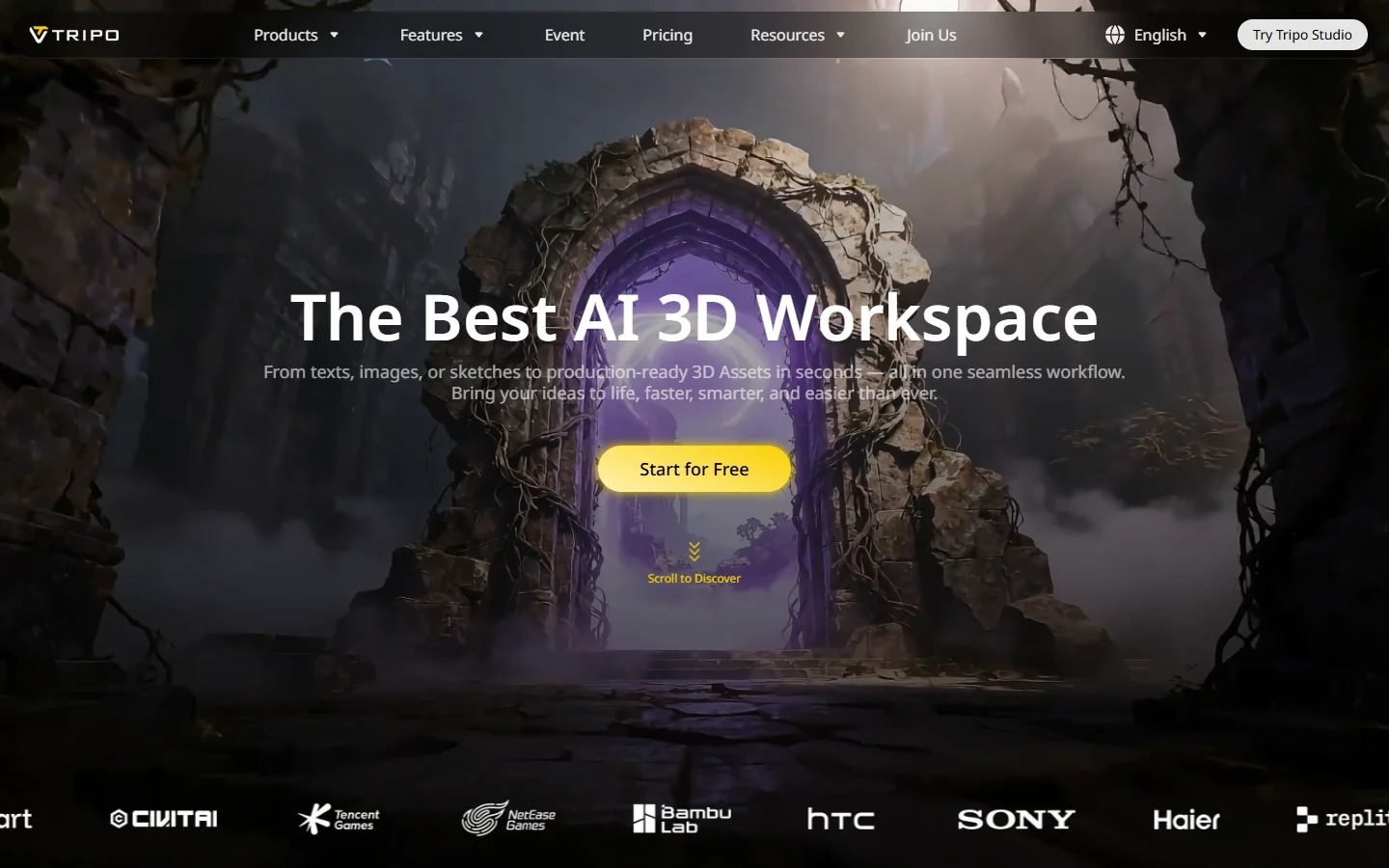
FreemiumTripo AI generates textured 3D models from text prompts or reference images in standard file formats ready for game engines and design tools.
📋 About Tripo AI
Tripo AI is a tripo ai text-to-3D and image-to-3D model generation platform that produces ready-to-use 3D assets from text descriptions or reference images in a fraction of the time required for manual 3D modeling. The platform targets game developers, product designers, and creators who need 3D assets but lack the time or technical skill to model them in traditional software. A text prompt or uploaded reference image is enough to initiate generation, and the resulting model is available for download in standard 3D file formats compatible with major game engines and design tools.
Tripo AI's generation pipeline produces models with mesh topology and textures applied, rather than producing point clouds or other intermediate formats that require significant post-processing before they are usable. The platform offers options to adjust the generation for different use cases — game-ready assets with optimized polygon counts, high-detail versions for rendering, or base meshes for further manual refinement in tools like Blender or Maya. This flexibility makes the output applicable to multiple production contexts.
The freemium model provides a limited number of free generations, with paid plans for production-volume use. Tripo AI is positioned for creators and small studios that need to accelerate asset creation rather than enterprise-scale game studios with dedicated 3D art pipelines, though the quality of outputs has been increasing with each model update.
⚡ Key Features of Tripo AI
Text-to-3D Generation
Generates complete 3D models with textures from natural language text descriptions of the desired object, character, or environment element. Prompts are processed through AI models trained on large 3D asset datasets to produce geometry and surface materials that match the description. Multiple generation outputs are typically provided so users can select the best match rather than being limited to a single result. The text interface removes the requirement for 3D modeling experience to produce usable assets.
Image-to-3D Conversion
Converts a single reference image into a textured 3D model by inferring the 3D geometry from the 2D visual. This is useful when a creator already has a concept illustration, product photo, or character design they want to turn into a 3D asset. The resulting model preserves the visual characteristics of the reference image on the generated geometry. Image-to-3D generation bridges the gap between 2D concept art workflows and 3D production.
Textured Mesh Output
Produces output as a textured mesh rather than a raw point cloud or geometry-only file, making the asset immediately usable in rendering and game engine contexts without separate texturing steps. Textures are generated and applied to the mesh UV map during generation rather than requiring a separate texturing workflow. Output files are provided in formats including GLB, OBJ, and FBX to match the requirements of different downstream tools. This directly reduces the post-processing work required to go from generation to usable asset.
Game-Ready Asset Optimization
Offers output settings optimized for game engine use with polygon counts and texture resolution appropriate for real-time rendering rather than offline render quality. Game-ready output reduces the manual retopology work that typically follows high-detail 3D generation. Users select their target output context to receive geometry appropriate to that use case without manual optimization. This is important for teams using generated assets in interactive applications with polygon budget constraints.
API Access for Production Pipelines
Provides API access for teams that want to integrate Tripo AI 3D generation into automated asset production workflows or custom tools. API integration enables batch generation, programmatic parameter control, and output delivery to downstream systems without using the web interface for each asset. This is useful for game studios or platforms that want to use Tripo AI as a generation layer within a larger production pipeline. API access is available on paid plans.
Model Refinement Compatibility
Generated models are exported in formats that allow continued manual refinement in standard 3D software including Blender, Maya, and ZBrush. This positions Tripo AI as an accelerator for traditional 3D workflows rather than a full replacement — artists can use AI-generated base meshes as starting points and refine them manually to production quality. The combination of automated generation for rough assets and manual refinement for final polish is a practical hybrid workflow for small teams.
🎯 Use Cases for Tripo AI
⚖️ Tripo AI Pros & Cons
Advantages
- ✓Text and image inputs remove the technical barrier to 3D asset creation for non-specialists
- ✓Textured mesh output is immediately usable in engines and rendering tools without additional processing
- ✓Game-ready optimization reduces retopology work for real-time application use
- ✓Standard file format export is compatible with the full range of 3D production tools
- ✓Freemium access allows testing generation quality before committing to a paid plan
Drawbacks
- ✗Output quality and geometric accuracy are below what a skilled 3D artist produces for production-ready assets
- ✗Complex multi-part objects and characters with articulation require significant manual cleanup after generation
- ✗Free tier generation limits are low for users evaluating the tool for production use cases
- ✗Texture quality and UV layout may require manual correction before use in high-fidelity rendering
📖 How to Use Tripo AI
Create an account at tripo3d.ai and log in to the generation dashboard.
Choose the generation mode — text-to-3D for prompt-based creation or image-to-3D for reference-based conversion.
Enter a detailed text prompt describing the object or character, or upload a reference image for image-to-3D generation.
Select the output type appropriate to your use case such as game-ready or high-detail render quality.
Review the generated models and select the output that best matches your requirements.
Download the model in your preferred format (GLB, OBJ, FBX) and import it into your 3D software or game engine.
❓ Tripo AI FAQ
Tripo AI is used to generate 3D models from text descriptions or reference images without manual 3D modeling. It produces textured meshes in standard file formats for use in game engines, 3D rendering tools, and design applications.
Tripo AI exports models in GLB, OBJ, and FBX formats, covering the major file types used by game engines such as Unity and Unreal Engine, and 3D software including Blender and Maya.
Tripo AI offers a freemium model with a limited number of free generations available at no cost. Paid plans are required for higher generation volumes and API access for production pipeline integration.
Both Tripo AI and Meshy AI generate 3D models from text and image inputs. They operate on similar generation principles with output quality and feature sets that are closely competitive. Tripo AI is noted for speed of generation, while specific differences in mesh topology quality and texture output are best evaluated by generating test assets in both platforms for a given use case.
Commercial use rights for Tripo AI generated models are governed by the platform's terms of service based on the subscription tier. Review the current terms at tripo3d.ai before using generated assets in commercial products.
Related to Tripo AI


Featured on WhatIf.ai
Add this badge to your website to show you're listed on WhatIf AI
Alternatives to Tripo AI

Aragon AI
Aragon AI professional headshot generator that creates studio-quality portrait photos from uploaded selfies using a personalized AI model.

ArtGuru AI
ArtGuru AI generates images from text prompts in a wide range of artistic styles, with additional tools for face enhancement, background removal, and image upscaling.


Dezgo AI
Dezgo AI is a free text-to-image generator powered by Stable Diffusion models, offering multiple model options and image editing tools in the browser.


Dzine AI
Dzine AI graphic design platform that combines AI image generation with templates and design tools for ready-to-use marketing visuals.